Apps
Web and mobile products with real screens, real data and a real database behind them.
The AI Software Factory
Build apps, automations, websites and businesses through conversation. Atlas designs, codes, deploys and evolves your ideas — from the first sentence to something running in production.
No account to start · Runs on your machine · Your code stays yours
Section 01 · Integrations
Describe what you want and watch it get built — same as you are used to. The difference is what you are left holding: a normal Git repository, running on your own machine, with the AI model of your choosing, built by something that reads your whole codebase before it changes any of it.






Already built something there? It syncs to GitHub — and that is where Atlas picks it up. Nothing to export.
Describe what you want. Atlas turns it into working software, keeps track of the decisions behind it, and helps you move from idea to launch without becoming a full-time project manager.
Your project lives in a normal Git repository from day one — the same one you launch from and keep changing, not a copy that drifts. Hire a developer next year and they open it and start working: no export, no migration, no generated code nobody can maintain.
No vendor lock-in, in the literal sense. It plugs into what you already use — GitHub or GitLab, Supabase, Obsidian, Telegram, WhatsApp — and which AI model runs is your call. Take any piece out and the project still runs.
You describe the product; Atlas turns it into a plan you can read before any code exists. You approve the shape of the thing, not a wall of files.
Every change is reviewed by a second model before it reaches you, and nothing lands until you say so.
Decisions, requirements and documentation stay attached to the code, so month six does not have to reconstruct what month one meant.
You do not have to be at your desk. Answer from your phone and the work keeps moving.
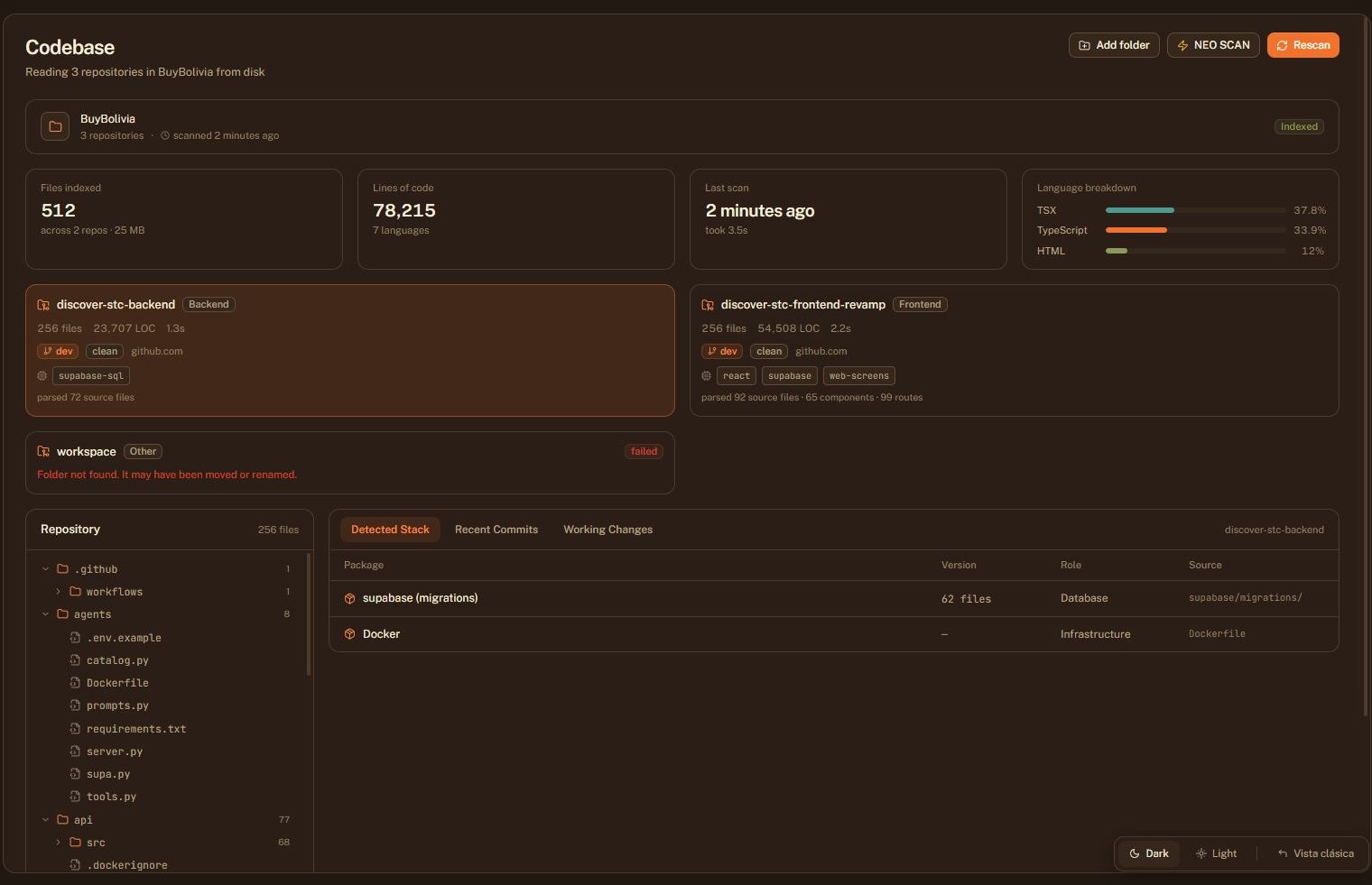
Atlas reads the repositories first, maps how everything connects, and keeps that understanding between sessions. The larger the project gets, the more that context is worth.
Cross-repository understanding — frontend call sites resolved to the backend routes they actually hit, not to the ones with a matching name.
Real schema awareness, read straight from your SQL migrations: tables, foreign keys, RLS policies. No database credentials, no drift.
Project-wide dependency mapping, so you know what a change touches before you make it — usage counts come from the import graph, not from guessing.
Your conventions and your never-do rules are enforced on every agent and every reviewer, instead of pasted into a prompt and hoped for.
Agents work in parallel without standing on each other, and they cover the unglamorous half too: automations, integrations, QA and tests.
The context survives the session. Close the laptop, come back Monday, and it still knows the project.
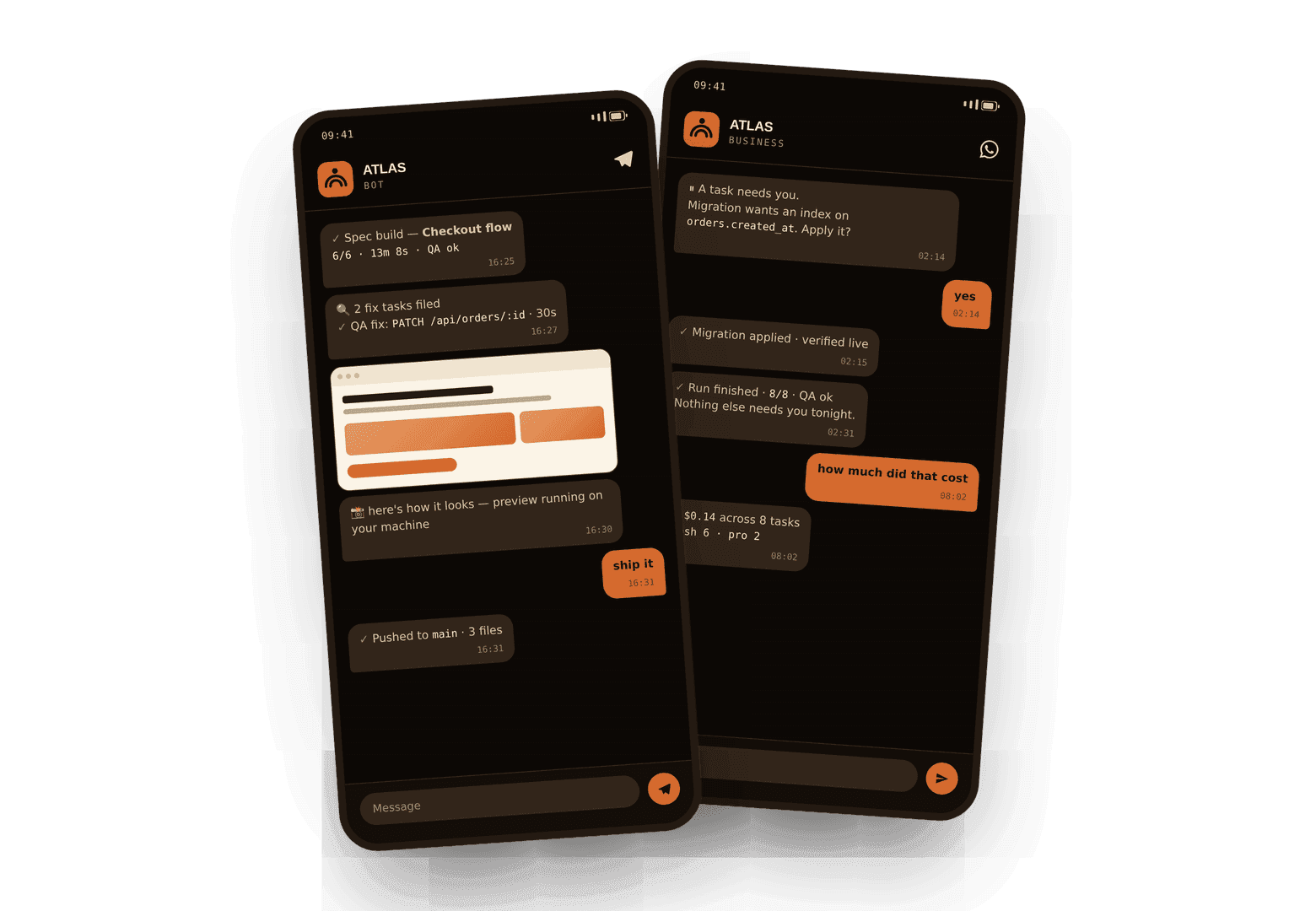
Atlas tells you when a run finishes, when a task needs a decision, and what it cost. Answer from your phone and the line keeps moving — Telegram or WhatsApp, your choice.
Atlas has no model of its own and resells nobody else's. You bring the key — Claude over MCP on the subscription you already pay for, DeepSeek by the token, whatever fits the job and the budget.
Section 02
Atlas is not a template gallery. It reads your codebase, keeps a map of it, and writes into it — which is why the second thing you build is easier than the first.
Web and mobile products with real screens, real data and a real database behind them.
Accounts, billing, plans and permissions — the plumbing every product needs and nobody enjoys.
Landing pages, marketing sites and documentation that ship the same afternoon you describe them.
The dashboard, the admin panel, the exporter — the software that only your team will ever open.
Jobs that run on a schedule, react to a webhook, or watch a table and do something about it.
Assistants that read your data, use your tools and answer for themselves — inside your product.
Section 03
Plain language, in the chat. A sentence is enough to start; Atlas asks for the rest.
It plans the work, writes the code and shows you every change as a diff you approve.
The live preview runs on your machine. Click any element and ask for the change out loud.
Only when you want it. Your projects sync across machines and stay yours.
One command from the same window that built it. Then keep evolving it the same way.
Section 04
Not a chat window bolted onto an editor. Atlas keeps a map of your whole system — every repository, route, table, component and document — and every agent it runs works from that same map.
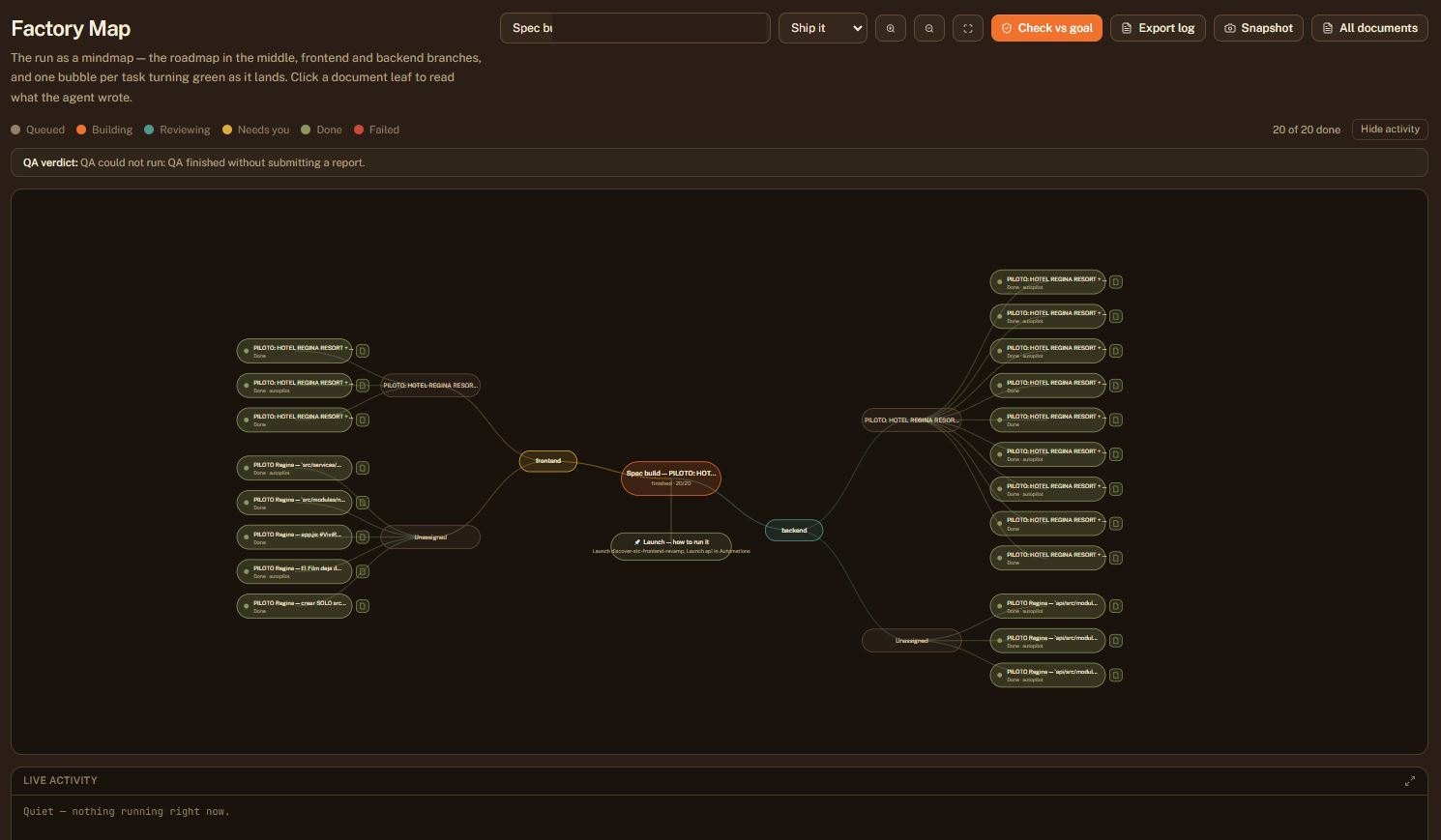
You watch the run happen: tasks turning green one by one, the diff of every file it touched, and the documents it wrote about its own work.




Section 05

Tom Röder
Founder · Solutions engineer
Tom Röder spent years building localization pipelines for enterprise clients, then built a computer-assisted translation tool from scratch — with its own multilingual file format and parsers. Atlas came out of wanting to build more, not less.
Read the full storySection 06
Atlas is early, which is the useful part. What ships next is still being decided, and the people who show up now get to decide some of it.
You will find the edges faster than we will. Break it, tell us what you found, and help decide how the factory behaves.
One person, five jobs, no time. Atlas was built for exactly that — tell us where it falls short and we fix it in the open.
Client work, real deadlines, no patience for tooling that half-works. Run Atlas on a live project and your blockers jump the roadmap.
Databases, hosting, auth, observability. Atlas connects to the stack our users already run — yours could be next.
Workshops, talks and demos — in Berlin or remote. Happy to show the factory running live.
Prefer email? hello@startupglobal.ai
Early access · Free while it lasts
Founding members get early access and founding pricing when Atlas launches. One email, nothing else, and you can leave the list whenever you want.
Join the waitlist